India's Free Trade Agreement (FTA) network has expanded significantly over the past decade, creating a complex web of preferential trade arrangements that offer substantial duty savings for Indian exporters — but only for those who understand and comply with the intricate rules that govern them.
The Current Landscape of India's FTA Network
India currently has operational FTAs, Preferential Trade Agreements (PTAs), and Comprehensive Economic Cooperation Agreements (CECAs/CEPAs) with over 15 countries and trading blocs. The most significant include:
- The India-UAE Comprehensive Economic Partnership Agreement (CEPA) — operational since May 2022
- The India-ASEAN Free Trade Agreement — covering all 10 ASEAN member states
- The India-Korea CEPA — one of India's most comprehensive agreements
- The India-Japan CEPA — covering goods, services, and investment
- The South Asian Free Trade Area (SAFTA) — covering the SAARC region
- The India-Australia Economic Cooperation and Trade Agreement (ECTA) — operational since December 2022
Additionally, India is actively negotiating FTAs with the European Union, the United Kingdom, and several other major trading partners. These negotiations, if concluded, will significantly expand the preferential market access available to Indian exporters.
Understanding the Opportunity: Duty Savings
The primary commercial benefit of FTAs is the reduction or elimination of import duties in the partner country. For Indian exporters, this means their products can enter the partner market at a lower cost than competitors from non-FTA countries — creating a significant price advantage.
"Our analysis indicates that Indian exporters claim preferential tariff benefits on only a fraction of eligible trade. The unclaimed duty savings likely run into hundreds of crores annually across all FTAs combined."
However, these duty reductions are not automatic. To claim preferential tariff rates, exporters must satisfy specific Rules of Origin requirements and follow prescribed documentation procedures.
The Compliance Challenge: Rules of Origin
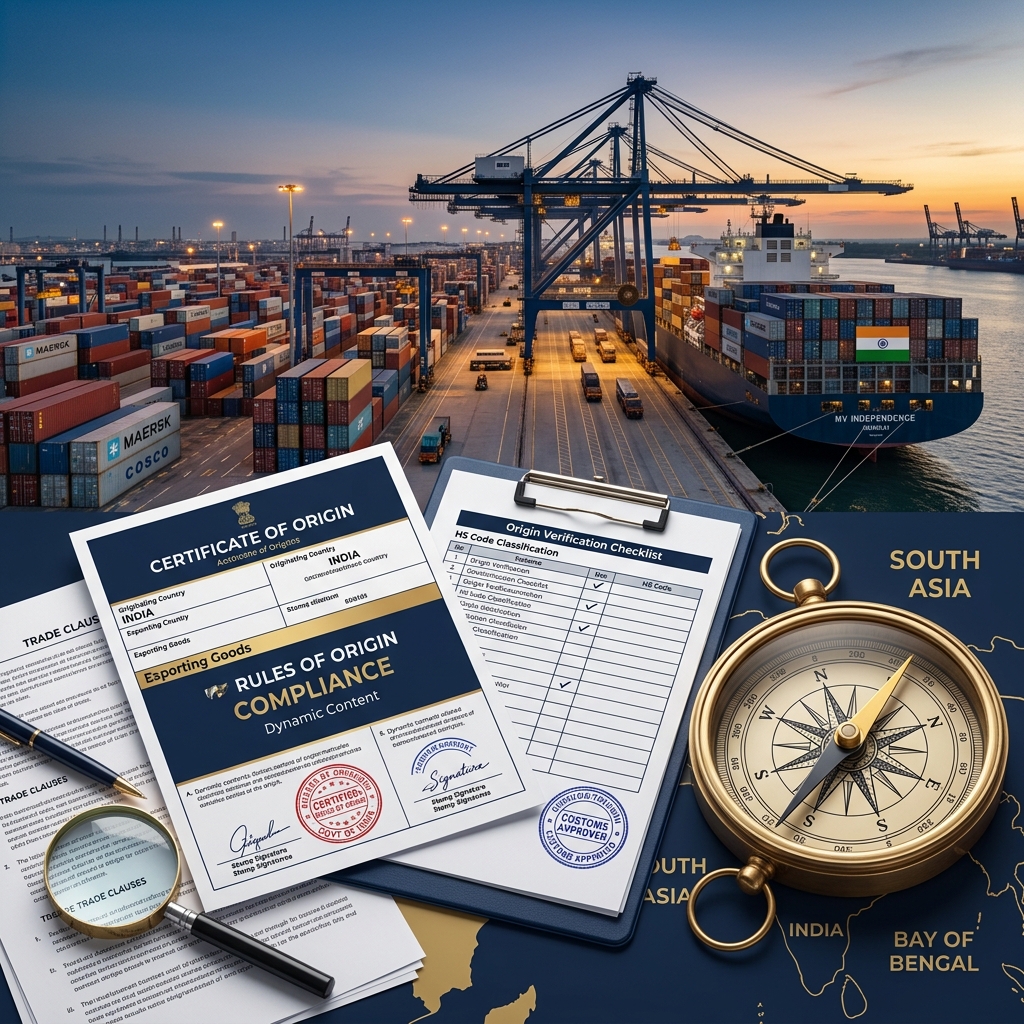
Every FTA contains Rules of Origin (RoO) provisions that define the conditions under which a product qualifies as "originating" in India and is therefore eligible for preferential duty treatment. These rules vary by agreement and by product, creating a complex compliance landscape.
Types of Origin Criteria
The most common origin criteria used in India's FTAs include:
- Change in Tariff Classification (CTC): The finished product must have a different HS classification than any non-originating material used in its production
- Regional Value Content (RVC): A minimum percentage of the product's value must be added within India (typically 35–45%)
- Process Rules: Specific manufacturing processes must be performed in India
- Wholly Obtained: The product must be entirely grown, mined, or manufactured in India using only Indian-origin inputs
Common Pitfalls for Indian Exporters
Our experience advising Indian exporters on FTA compliance has revealed several recurring issues that lead to rejected claims, duty recovery demands, and even anti-fraud investigations:
- Inadequate Bill of Materials documentation that cannot prove origin
- RVC miscalculation due to incorrect treatment of packaging, freight, or overhead costs
- Certificate of Origin errors — wrong format, missing signatures, incorrect HS codes
- Direct consignment violations — goods transiting through third countries without proper documentation
- Cumulation misunderstandings — assuming inputs from any FTA partner qualify when cumulation provisions differ by agreement
Building a Robust FTA Compliance Program
At LawSet Legal, we recommend that every exporter claiming FTA benefits implement a structured compliance program that includes:
- Product-by-product origin determination for all exported HS codes
- Systematic BOM analysis and RVC calculation with quarterly updates
- Certificate of Origin management procedures with internal verification steps
- Direct consignment documentation protocols
- Verification defence preparedness — maintaining records for a minimum of 5 years
- Regulatory change monitoring — tracking amendments to FTA rules and tariff schedules
Looking Ahead: India-EU and India-UK FTAs
The ongoing negotiations with the EU and the UK represent potentially transformative opportunities for Indian exporters. If concluded, these agreements would provide preferential access to two of the world's largest consumer markets, with particularly significant implications for India's textile and apparel sector, pharmaceuticals, and automotive components.
However, both agreements are expected to include stringent origin rules, comprehensive TBT and SPS provisions, and sustainability requirements that will require advance preparation by Indian exporters.
How LawSet Legal Can Help
Our FTA Compliance & Strategy practice helps Indian exporters navigate the full cycle of FTA utilisation — from initial opportunity identification through compliance program design, implementation, and verification defence.
If you are an exporter looking to understand your FTA options, or if you are already claiming FTA benefits and want to ensure your compliance program is robust, contact us for a consultation.